JWST Captures a Supernova from the Cosmic Dawn
7 minutes Read
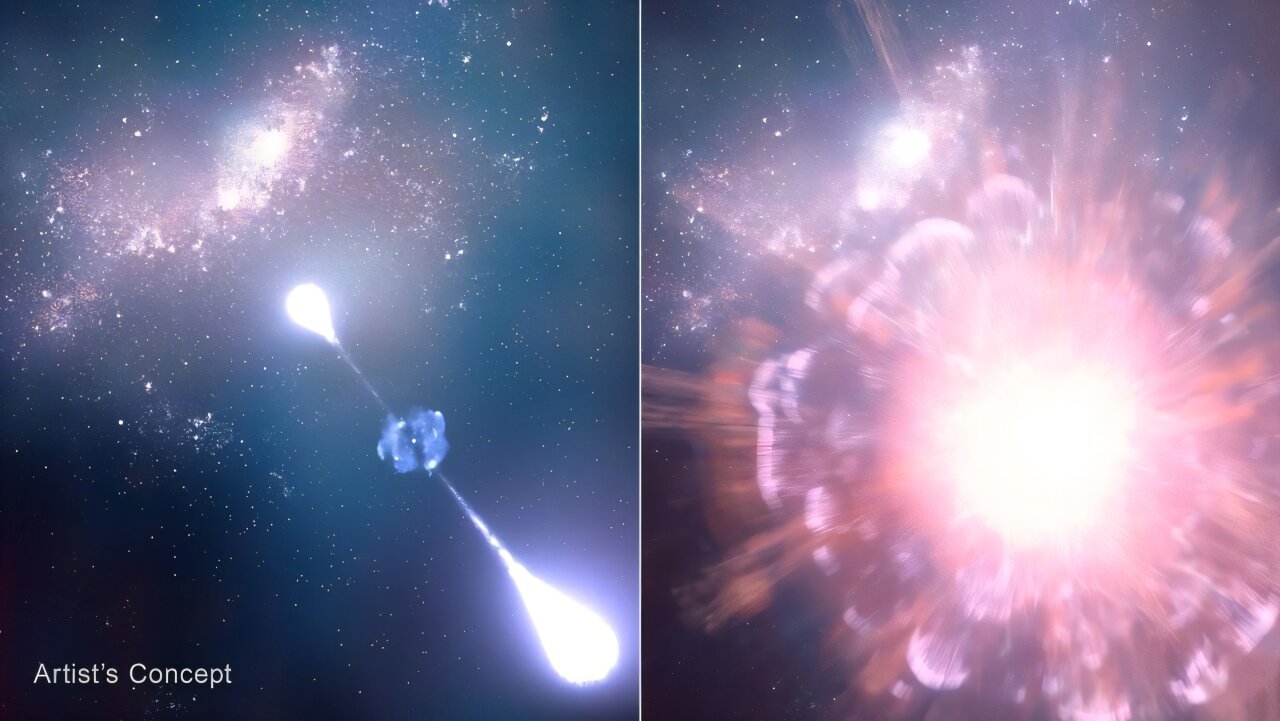
Astronomers have reported a remarkable observation from the early universe that sheds new light on how massive stars lived and died long ago. Using the James Webb Space Telescope (JWST), researchers have detected what appears to be a supernova associated with a powerful burst of gamma rays, at a redshift of about z ≈ 7.3. This places the event when the universe was only a few hundred million years old, deep in the era known as the epoch of reionisation.
The initial sign of this distant explosion came from an intense flash of high-energy light called a long-duration gamma-ray burst (GRB), labeled GRB 250314A, which was picked up by the Space-based multi-band astronomical Variable Objects Monitor (SVOM) in March 2025. These bursts are thought to occur when massive stars collapse at the end of their lives, producing both gamma-ray radiation and, in many cases, a supernova.
In the months that followed the GRB, the JWST team pointed the telescope at the same patch of sky and used its Near Infrared Camera (NIRCAM) to observe the faint light left behind. These observations enabled astronomers to separate the fading glow of the supernova from the much dimmer light of the tiny, distant host galaxy where the explosion originated.
One striking aspect of this discovery is that the supernova’s brightness and other properties resemble those of supernovae linked to gamma-ray bursts in the local universe, such as the well-studied SN 1998bw. That is surprising because the earliest stars lived in conditions very different from those around us today, with less heavy chemical elements. Yet, the explosion observed by JWST does not show the dramatic differences many had expected.
Because this event occurred so early in cosmic history, astronomers did not know in advance how similar or different early supernovae might look compared with those nearby. The new observations suggest that, at least in this case, massive stars in the young universe died in ways familiar to astronomers, even under distinct physical conditions.
The research team plans to conduct further JWST follow-up studies in the coming years. As the supernova’s light continues to fade, these observations will help refine measurements of the host galaxy’s properties and confirm exactly how much of the observed light came from the explosion itself.
Original source:
JWST reveals a supernova following a gamma-ray burst at z ≃ 7.3, Astronomy & Astrophysics.
https://www.aanda.org/articles/aa/full_html/2025/12/aa56581-25/aa56581-25.html