The Atmospheric Composition of TOI-270 d: New Insights from JWST Observations
10 minutes Read
Introduction
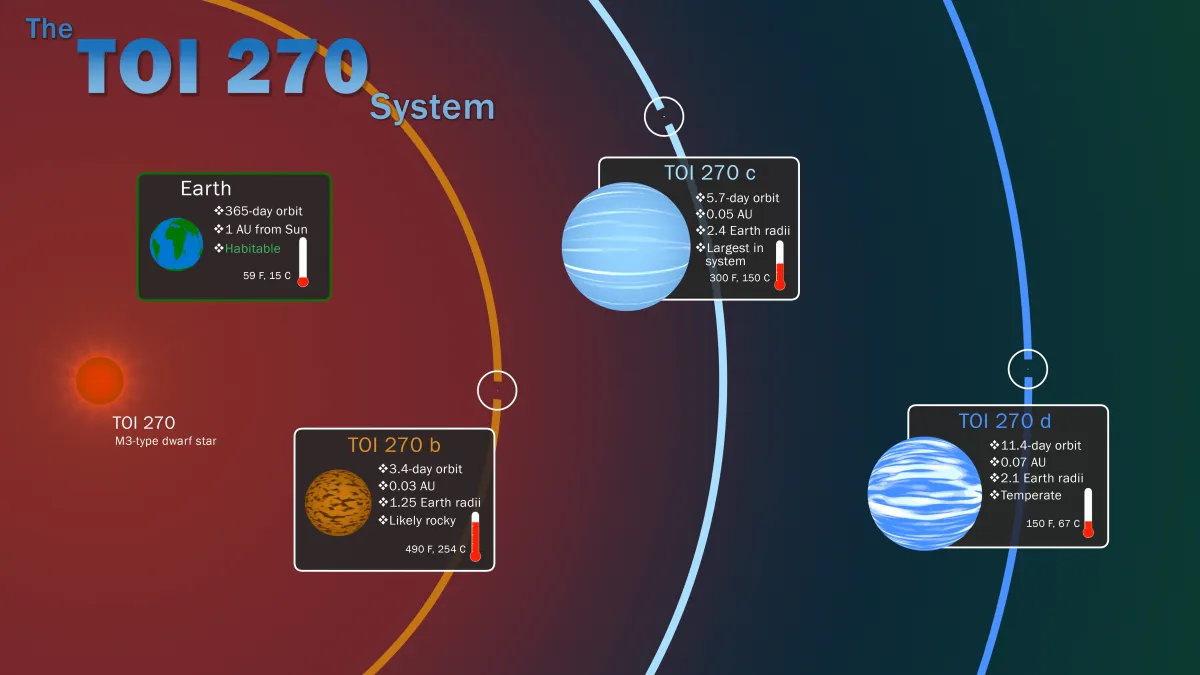
The study of temperate sub-Neptune exoplanets has entered a transformative phase with the James Webb Space Telescope (JWST). Among these worlds, TOI-270 d stands out as a compelling target due to its size, temperature, and potential for exotic atmospheric conditions. While its bulk properties could correspond to multiple internal structures, researchers have now focused on the planet’s observable atmosphere to better understand its nature.
Previous JWST observations of TOI-270 d had yielded conflicting interpretations. Some analyses suggested the planet could be a Hycean world, characterized by a hydrogen-rich atmosphere over a global liquid water ocean. Others proposed a mixed-envelope sub-Neptune, where high temperatures prevent the formation of liquid oceans and lead to a denser atmosphere. To resolve these differences, the research team conducted a detailed retrieval analysis using recent NIRISS and NIRSpec transit spectroscopy data across wavelengths from 1 to 5 microns.
Findings
The analysis revealed that earlier inferences of a mixed-envelope atmosphere were influenced by specific modeling choices that produced unusually high temperatures and molecular weights. When accounting for these factors, the team confirmed that TOI-270 d possesses a hydrogen-rich atmosphere. Revised estimates for molecular abundances indicate detectable levels of methane (CH₄), carbon dioxide (CO₂), water (H₂O), and carbon disulfide (CS₂), with tentative indications of more complex molecules such as ethane (C₂H₆) or dimethyl sulfide (DMS).
The terminator temperature—the atmospheric temperature near the day-night boundary—was measured at approximately 10 mbar pressure, supporting the possibility of a Hycean or dark Hycean configuration. In this scenario, liquid water could exist either planet-wide or on the nightside, although additional observations are needed to robustly confirm these conditions.
Implications
These findings help clarify TOI-270 d’s atmospheric composition and suggest that temperate sub-Neptunes may harbor environments conducive to liquid water under certain conditions. They also illustrate the sensitivity of atmospheric interpretations to modeling assumptions, highlighting the need for comprehensive analyses using multiple instruments and extended wavelength coverage.
Overall, TOI-270 d remains a prime example of how JWST is reshaping our understanding of exoplanets, demonstrating the telescope’s ability to resolve subtle atmospheric signatures and explore the potential for exotic planetary environments.
Original source: The atmospheric composition of TOI‑270 d, arXiv. https://arxiv.org/pdf/2511.13830