Webb Telescope Uncovers Mysterious Galaxies Resembling Platypuses
7 minutes Read
Introduction
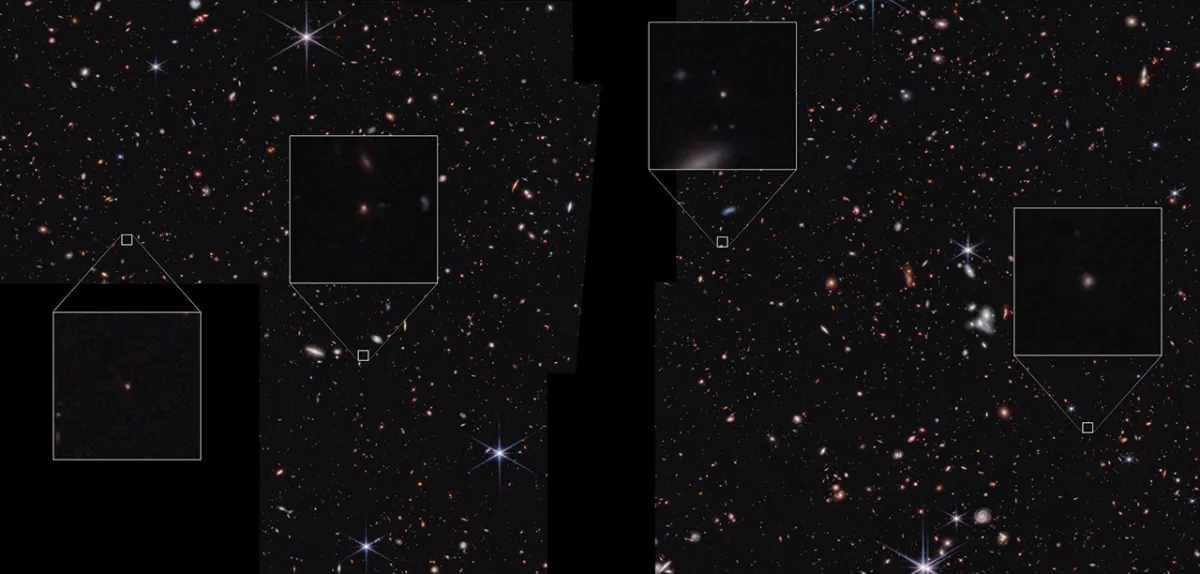
Astronomers sifting through data from NASA's James Webb Space Telescope have identified a group of galaxies exhibiting a combination of characteristics never before seen. Principal investigator Haojing Yan of the University of Missouri likens this discovery to the platypus in biology, an animal that defies easy categorization due to its unique mix of traits. This new population of galaxies is described as extremely tiny and compact, appearing almost like a point source, yet lacking the expected signatures of a quasar, which are typically active supermassive black holes that dominate distant point-like observations.
The research, presented at the 247th meeting of the American Astronomical Society in Phoenix, highlights the power of the Webb telescope to reveal unexpected cosmic phenomena. Four of the nine galaxies in this newly identified "platypus" sample were initially found in the Cosmic Evolution Early Release Science Survey (CEERS) conducted by Webb. A key distinguishing feature is their point-like appearance, even when observed with Webb's unparalleled detail-capturing capabilities.
Uncategorizable Cosmic Oddities
The team's initial reaction to these galaxies was one of surprise, with Yan remarking that their coexisting characteristics seemed improbable but were undeniably present. The researchers meticulously analyzed a sample of 2,000 sources from various Webb surveys, ultimately isolating nine point-like objects dating back 12 to 12.6 billion years, a period relatively early in the universe's 13.8 billion-year history. Spectral data, which offers more information than images alone, proved crucial. For these nine sources, the spectral data did not align with existing classifications. They were too distant to be stars within our own galaxy and too faint to be quasars, which are known for their immense brightness that overshadows their host galaxies. While their spectra share some resemblance with the less distant "green pea" galaxies discovered in 2009, these newly found galaxies are significantly more compact.
Yan drew a parallel to the platypus again, noting how its detailed genetic code reveals its unusual nature by sharing features with birds, reptiles, and mammals. Similarly, Webb's combined imaging and spectral data are indicating that these galaxies possess an unexpected assortment of features. Yan further elaborated that the characteristic spectral emission lines of typical quasars present broad-based peaks, signifying the high velocity of gas orbiting their supermassive black holes. In contrast, the peaks observed in the spectra of this "platypus population" are narrow and sharp, suggesting slower gas movement. Although narrow-line galaxies hosting active supermassive black holes do exist, they do not exhibit the point-like appearance of the sample identified by Yan's team.
Signatures of Early Galaxy Formation?
Following the determination that these objects did not fit the definition of quasars, graduate student researcher Bangzheng Sun undertook an analysis to detect signatures of star-forming galaxies. The low-resolution spectra available at the time could not rule out the possibility that these nine objects are indeed star-forming galaxies, a conclusion that aligns with the data. However, the perplexing aspect remains their exceptionally small and compact size, especially considering Webb's resolution capabilities at such vast distances.
One hypothesis proposed by the team is that Webb is providing unprecedented views of earlier stages of galaxy formation and evolution. The prevailing scientific consensus is that large galaxies, such as our Milky Way, grow through the merger of many smaller galaxies. Yan poses a fundamental question: what precedes the formation of these small galaxies? This new research prompts an inquiry into the very beginnings of the galaxy formation process. Could such small, foundational galaxies form in a quiescent manner, prior to the onset of chaotic mergers, as their point-like appearance might suggest?
To address these questions and to better understand the nature of these cosmic "platypuses," the team requires a larger sample size than the current nine objects and needs to analyze higher-resolution spectra. Yan mentioned that these nine objects were not the primary focus of the initial broad Webb surveys but were discovered serendipitously in the background. The current task is to contemplate the implications of this discovery and to devise strategies for utilizing Webb's capabilities to gain further insights. The James Webb Space Telescope serves as the world's foremost space science observatory, dedicated to unraveling mysteries within our solar system, exploring distant exoplanets, and investigating the universe's structure and origins, including humanity's place within it. Webb is an international collaboration involving NASA, the European Space Agency (ESA), and the Canadian Space Agency (CSA).
Original source: "https://science.nasa.gov/missions/webb/scientists-identify-astronomys-platypus-with-nasas-webb-telescope/"