Webb Telescope Uncovers Rare Dust in Primitive Galaxy, Reshaping Early Universe Insights
7 minutes Read
Introduction
Astronomers wielding the powerful gaze of NASA's James Webb Space Telescope have made a remarkable discovery in the dwarf galaxy Sextans A, a celestial neighbor to the Milky Way that retains some of the universe's most primitive characteristics. The telescope has detected two uncommon types of dust: metallic iron dust and silicon carbide, both products of aging stars. This finding, along with the presence of minuscule carbon-based molecules, suggests that even in the nascent stages of the universe, when heavier elements were scarce, stars and the surrounding interstellar medium were capable of forging solid dust grains. These observations are fundamentally altering our understanding of how early galaxies evolved and developed the essential components for planet formation, contributing to NASA's ongoing exploration of the universe's secrets.
Sextans A, located approximately 4 million light-years away, is notable for its extremely low "metallicity," the astrophysical term for elements heavier than hydrogen and helium. It contains only about 3 to 7 percent of the heavy element content found in our Sun. Due to its small size and consequently weak gravitational pull, Sextans A struggles to retain the heavier elements produced by events like supernovae and the life cycles of stars, unlike many other nearby galaxies. This makes it a unique natural laboratory, closely resembling the galaxies that populated the universe shortly after the Big Bang, a time when the cosmos was predominantly composed of hydrogen and helium before stars had a chance to seed space with these "metals." Its relative proximity offers astronomers a rare opportunity to examine individual stars and interstellar clouds under conditions that mirror those of the early universe.
Stellar Dust Factories at Low Metallicity
One of the studies, detailed in the Astrophysical Journal, focused on a select group of stars within Sextans A using the low-resolution spectrometer of Webb's Mid-Infrared Instrument (MIRI). The data gathered provided chemical signatures of these stars in their advanced evolutionary phase, known as asymptotic giant branch (AGB) stars. These are stars with masses ranging from one to eight times that of our Sun, which undergo this specific stage of their lives.
Martha Boyer, an associate astronomer at the Space Telescope Science Institute and lead author of this study, explained the surprising findings. "One of these stars is on the high-mass end of the AGB range, and stars like this usually produce silicate dust," she stated. "However, at such low metallicity, we expect these stars to be nearly dust-free. Instead, Webb revealed a star forging dust grains made almost entirely of iron. This is something we’ve never seen in stars that are analogs of stars in the early universe."
Normally, oxygen-rich stars create silicate dust, a process that requires elements like silicon and magnesium. In Sextans A, these elements are virtually absent, akin to attempting to bake without essential ingredients like flour, sugar, and butter. A typical cosmic environment, such as the Milky Way, is rich with these necessary components—silicon, carbon, and iron. In a primitive environment like Sextans A, with a severe lack of these ingredients, the expectation was that stars would be unable to "bake" much dust at all. However, the Webb telescope not only detected dust but also revealed that one star employed a completely different method for its creation. The discovery of iron-only dust, alongside silicon carbide produced by less massive AGB stars despite the galaxy's low silicon abundance, demonstrates that evolved stars can still manufacture solid material even when the typical ingredients are missing. Boyer further commented, "Dust in the early universe may have looked very different from the silicate grains we see today. These iron grains absorb light efficiently but leave no sharp spectral fingerprints and can contribute to the large dust reservoirs seen in far-away galaxies detected by Webb."
Carbon Molecules in Sparse Environments
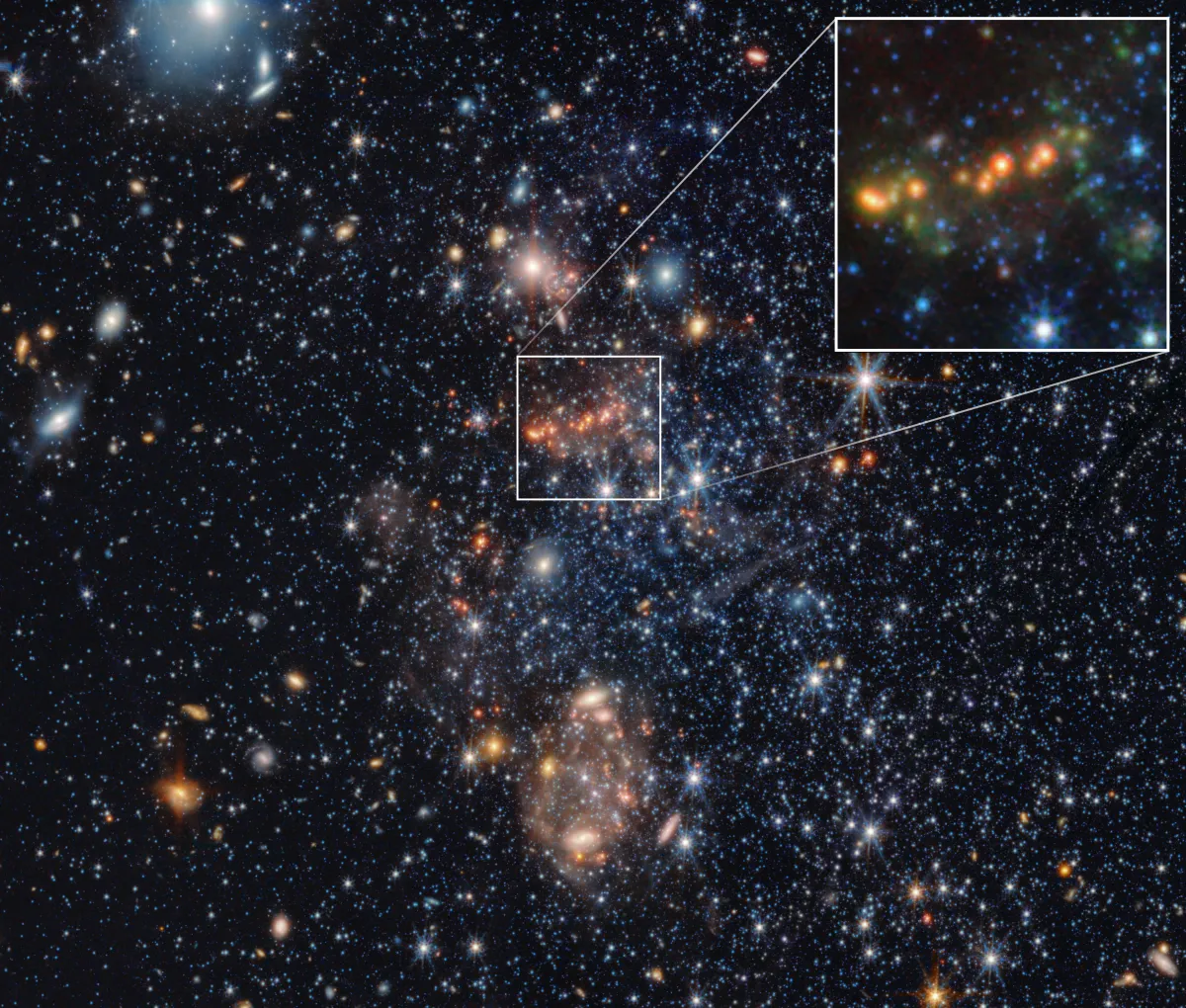
In a complementary study, currently undergoing peer review, Webb captured images of Sextans A's interstellar medium, identifying polycyclic aromatic hydrocarbons (PAHs). These complex carbon-based molecules are among the smallest dust grains and emit light in the infrared spectrum. This detection marks Sextans A as the galaxy with the lowest metallicity ever found to contain PAHs.
However, the way these PAHs manifest in Sextans A differs significantly from their appearance in metal-rich galaxies, where their emission is widespread. Webb's observations revealed PAHs concentrated in small, dense pockets, spanning only a few light-years across. Elizabeth Tarantino, a postdoctoral researcher at the Space Telescope Science Institute and lead author of this study, noted, "Webb shows that PAHs can form and survive even in the most metal-starved galaxies, but only in small, protected islands of dense gas." These clumps are believed to represent localized regions where dust shielding and gas density are sufficiently high to permit the formation and growth of PAHs, resolving a long-standing puzzle about why PAHs appeared to disappear in metal-poor galaxies. The research team has secured an approved Webb Cycle 4 program to conduct high-resolution spectroscopy, aiming to further investigate the detailed chemistry within these PAH clumps in Sextans A.
Conclusion
Taken together, these findings reveal that the early universe possessed a greater diversity of dust production mechanisms than previously understood, beyond established methods like supernova explosions. Furthermore, researchers now understand that dust is more abundant than predicted in environments with extremely low metallicities. "Every discovery in Sextans A reminds us that the early universe was more inventive than we imagined," said Boyer. "Clearly, stars found a way to make the building blocks of planets long before galaxies like our own existed." The James Webb Space Telescope, a premier global space science observatory, continues to unravel mysteries of our solar system, explore distant worlds, and probe the origins of the universe and our place within it. Webb is an international collaboration led by NASA, with partners the European Space Agency (ESA) and the Canadian Space Agency (CSA).
Original source: "https://science.nasa.gov/missions/webb/nasa-webb-finds-early-universe-analogs-unexpected-talent-for-making-dust"