Unlocking Early Universe Jets: The Case of Blazar OH 471
8 minutes Read
Introduction
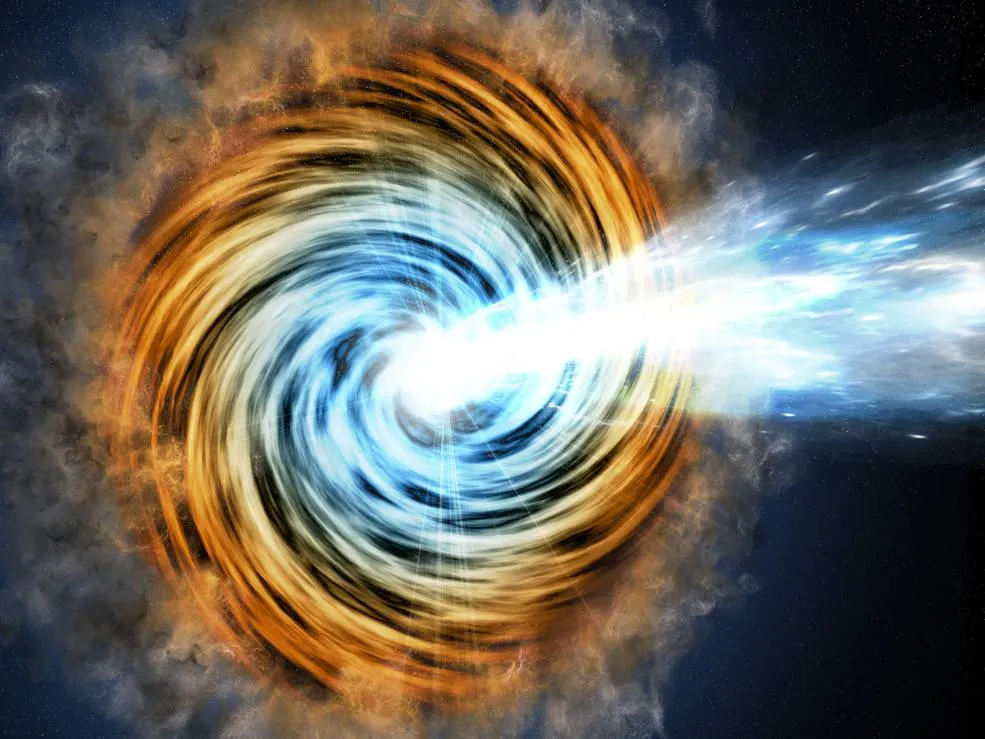
Understanding how supermassive black holes (SMBHs) in the early universe managed to launch and shape the powerful, relativistic jets observed in active galactic nuclei (AGNs) is a key puzzle in astrophysics. These jets play a crucial role in the co-evolution of SMBHs and their host galaxies over cosmic time. While previous studies have focused on AGNs at more moderate distances, examining objects in the early universe, such as the blazar OH 471, offers a unique opportunity to probe the physics of SMBH accretion and jet formation when the universe was much younger. This research delves into the mechanisms behind these early cosmic jets by analyzing the blazar OH 471, located at a significant redshift of z = 3.396.
Probing the Jet Launching Mechanism
To investigate how jets are launched from SMBHs in the early universe, scientists focused on the blazar OH 471. This object is a high-redshift (z = 3.396) blazar, meaning it is a type of active galactic nucleus with a relativistic jet pointed nearly towards Earth. Studying OH 471 provides a window into the conditions of jet formation when the universe was significantly younger than it is today. The research employed multi-frequency radio monitoring observations and high-resolution Very Long Baseline Interferometry (VLBI) imaging, spanning a period of three decades, to examine the structure and variability of OH 471 on milliarcsecond scales.
Radio Variability and Jet Structure
The study of OH 471's radio flux densities revealed a synchrotron self-absorbed spectrum, which is indicative of strong magnetic fields within the compact core of the source. By analyzing the spectral modeling of these radio flux densities, researchers could estimate the magnetic flux carried by the jet. This estimation is crucial because it allows for a comparison with theoretical predictions for jets powered by black hole spin energy, specifically through the Blandford-Znajek mechanism. The findings suggest that OH 471 is in a state known as a magnetically arrested disk (MAD). In this state, the accumulation of magnetic flux near the black hole's event horizon regulates the accretion flow, enabling efficient extraction of the black hole's rotational energy to power the jet.
The analysis of VLBI data over several decades provided insights into the jet's structure and motion. Observations revealed apparent superluminal speeds, indicating that the jet is highly relativistic. Component J2, located very close to the core, showed a proper motion corresponding to 4.4 times the speed of light. This fast motion, along with the long-term spectral evolution, supports the idea that flares are directly linked to the ejection of new jet components from the central engine. The temporal association between jet component emergence and radio flares suggests a direct connection between flaring activity and the expulsion of material from the core.
Radio Spectra and Magnetic Flux
The long-term monitoring of OH 471's radio spectrum has shown significant variability, with a notable evolution in the synchrotron self-absorption turnover frequency. This variability, coupled with detailed spectral modeling, allowed researchers to estimate the magnetic field strength and particle densities in the core region. The study found that the jet's magnetic flux reaches or even exceeds theoretical predictions for jets powered by the Blandford-Znajek mechanism, a process that relies on black hole spin energy. This observation strongly supports the MAD state for OH 471. The estimated jet magnetic flux values were compared to the predicted magnetic flux for a MAD state. The results indicated that the inferred jet magnetic flux surpasses the theoretical MAD threshold, especially during periods of rising activity, suggesting that the magnetic flux has accumulated sufficiently to trigger new jet ejection episodes. This strong magnetic flux is seen as the driving force behind the powerful jet observed from OH 471.
Furthermore, by comparing the magnetic flux of OH 471 with a sample of lower-redshift AGNs, the study found that OH 471 broadly aligns with the established relationship between jet magnetic flux and quantities related to accretion rate and black hole mass. This consistency suggests that the magnetic flux paradigm, which explains jet launching, remains applicable even in the early universe. The findings imply that the processes driving powerful jets are universal, extending from the local universe to earlier cosmic epochs.
Conclusion
The study of the high-redshift blazar OH 471 provides compelling evidence that the Magnetically Arrested Disk (MAD) accretion mode plays a dominant role in powering the prominent radio flares and relativistic jets observed in radio-loud AGNs in the early universe. The findings indicate that strong magnetic flux accumulation near the black hole's event horizon is essential for efficiently extracting black hole spin energy to launch these powerful jets. This research highlights the significance of MAD accretion in the growth of supermassive black holes and the formation of the earliest relativistic jets. Future statistical studies of larger samples of high-redshift AGNs are needed to further confirm the role of MAD accretion in shaping the early cosmic landscape.
Original source: "https://www.aanda.org/articles/aa/full_html/2024/05/aa49934-24/aa49934-24.html"