Searching for Close-In Planets Around TWA 7
7 minutes Read
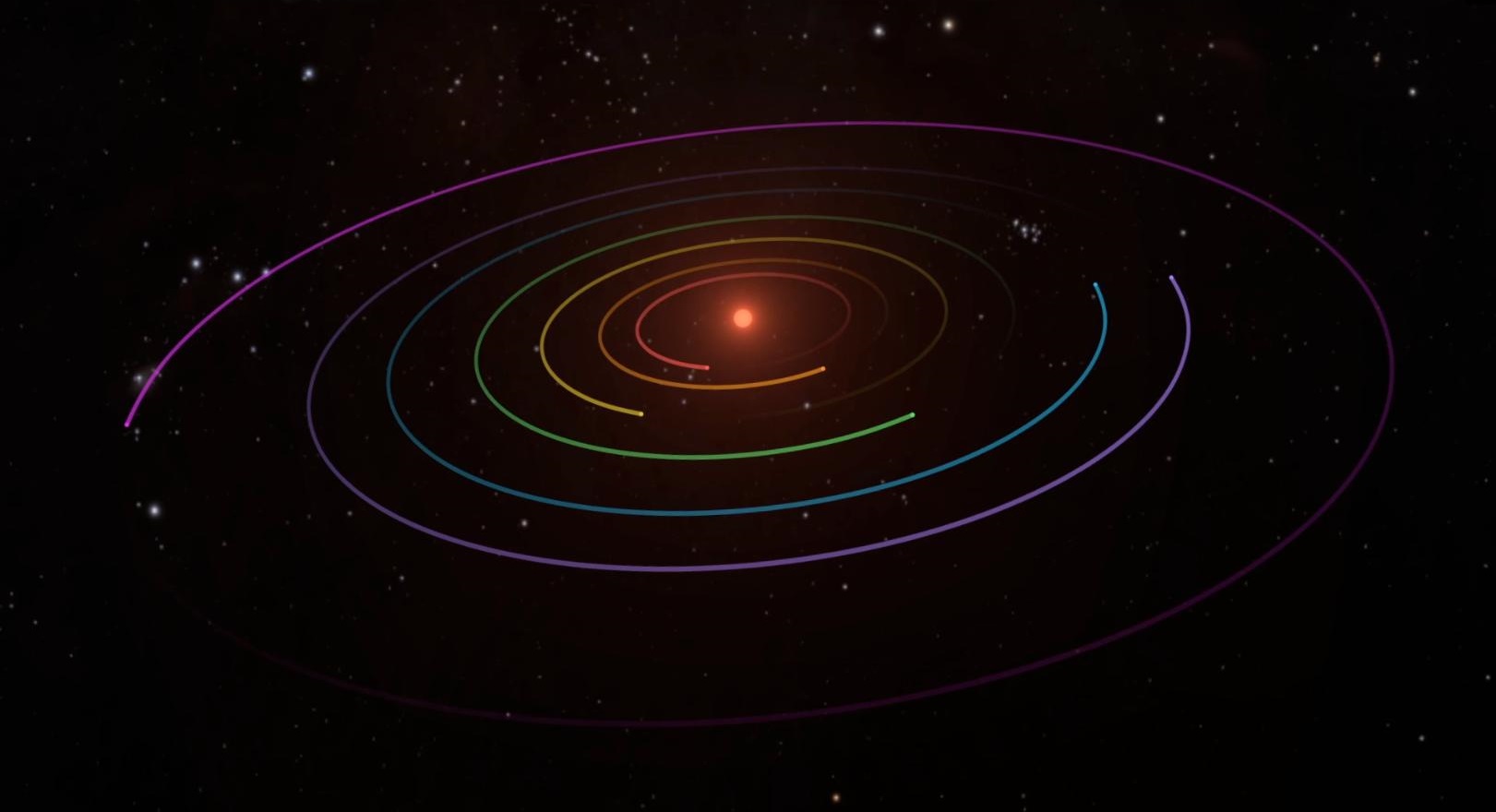
image: NASA / JPL-Caltech
Introduction
Astronomers continue to seek planets around stars beyond our solar system, especially those orbiting young and low-mass stars. One such star, TWA 7, a young M-dwarf, has drawn attention for its potential to host close-in planets. These planets, if present, would orbit very near the star, offering insights into planetary formation and dynamics in the early stages of stellar evolution.
Observational Approach
Researchers employed the SPIRou instrument, a high-resolution near-infrared spectropolarimeter mounted on the Canada-France-Hawaii Telescope, to observe TWA 7. Over a series of nights, the team collected spectropolarimetric data aimed at detecting variations in the star's radial velocity. These measurements are sensitive to gravitational influences from orbiting planets and allow astronomers to identify potential companions with short orbital periods.
In addition to planet detection, SPIRou enables the characterization of the star's magnetic activity. Young M-dwarfs like TWA 7 often exhibit strong magnetic fields and starspots, which can produce signals similar to those caused by planets. By analyzing both radial velocity and magnetic activity indicators, the team could distinguish stellar variability from planetary effects.
Data Analysis and Findings
The observations revealed complex radial velocity patterns. Some variations appeared consistent with potential planetary signals, but much of the variability was linked to stellar activity. The star exhibits magnetic field structures and rotation-induced signals that dominate the observed measurements. By modeling these effects, researchers constrained the presence of planets close to TWA 7. While the data does not confirm any specific planet, it allows upper limits to be set on the mass and orbital distance of hypothetical companions.
The study highlights the challenge of searching for close-in planets around young, magnetically active stars. Distinguishing subtle planetary signals from the star's own activity requires careful modeling and high-precision instruments like SPIRou. The results contribute to understanding the limits of planet detection in such dynamic environments.
Conclusion
This investigation of TWA 7 demonstrates the intricacies of planet hunting around young M-dwarf stars. While no planets were definitively detected, the high-resolution infrared data refined constraints on potential companions and improved knowledge of the star's magnetic characteristics. These findings underscore the importance of combining planet search techniques with detailed stellar characterization, providing a clearer picture of young planetary systems in formation.
Original source:
Searching for close-in planets around TWA 7 with SPIRou, Astronomy & Astrophysics.
https://www.aanda.org/articles/aa/full_html/2025/12/aa57322-25/aa57322-25.html