Galactic Mergers Leave Their Mark on Stellar Streams
7 Minutes Read
Introduction
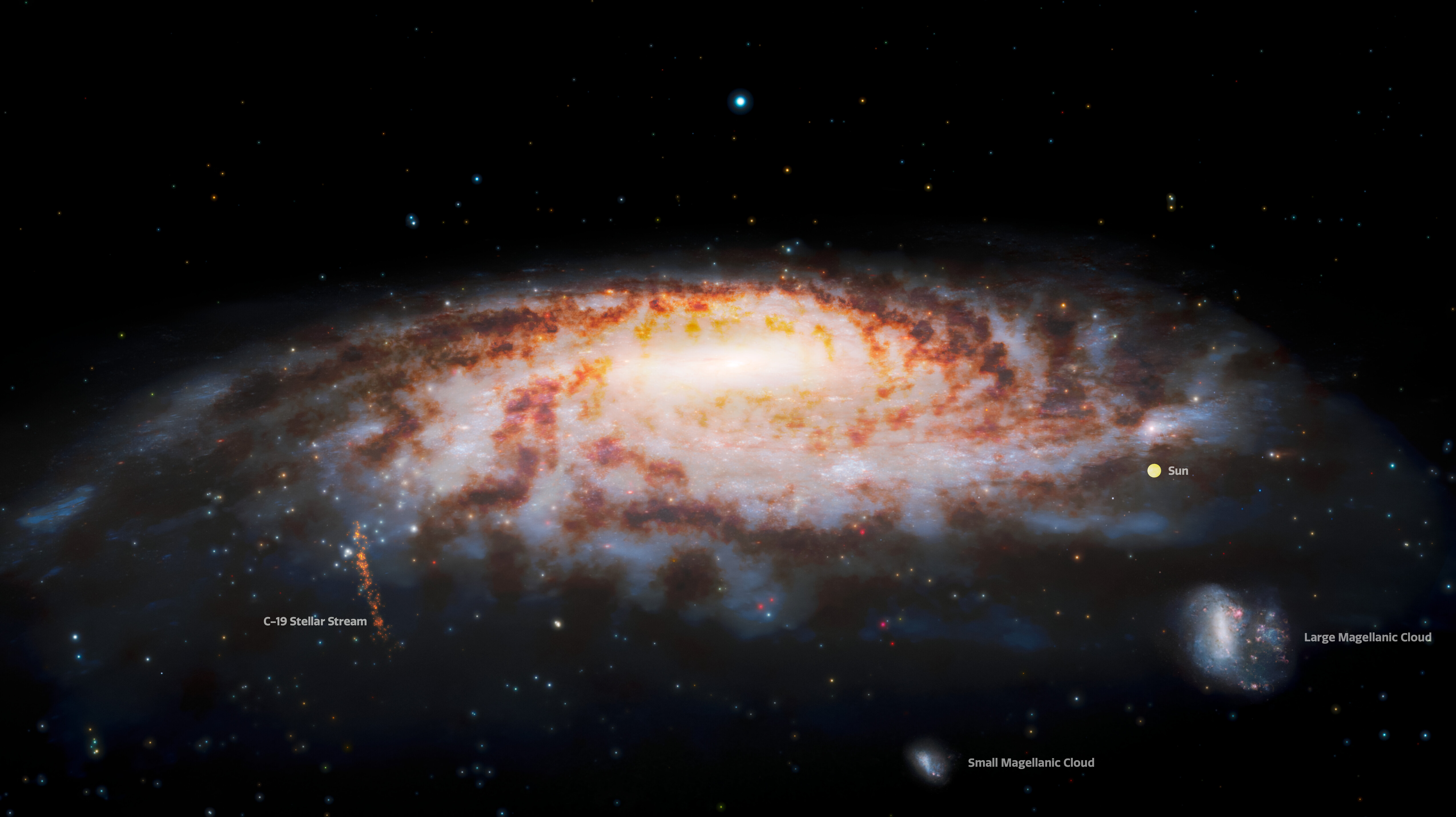
Stellar streams, vast trails of stars stripped from star clusters or smaller galaxies, are crucial for understanding the Milky Way's mass distribution and its history. These elongated structures are incredibly sensitive to gravitational influences, which can sculpt them into various forms, including gaps, clumps, and asymmetries. While much research has focused on how smaller objects like dark matter subhalos or giant molecular clouds perturb these streams, the impact of a major galactic merger on these delicate stellar populations has remained largely unexplored. This new study delves into how such cataclysmic events might imprint lasting asymmetries between the leading and trailing arms of stellar streams.
The research team used sophisticated N-body simulations to model a Milky Way-like galaxy that hosts a population of 36 globular cluster streams and undergoes a merger with a smaller galaxy. By analyzing these simulations, they developed a novel method to quantify the structural differences between the leading and trailing tails of these streams. Their findings suggest that while the overall signature of a merger across a population of streams might be subtle due to varied responses, individual streams, particularly those on wide orbits, can retain clear evidence of such violent interactions for billions of years. This provides a new avenue for reconstructing the assembly history of our galaxy.
Simulating a Galactic Collision
To investigate the impact of a galactic merger on stellar streams, the researchers employed a detailed N-body simulation. They created a realistic model of a Milky Way-like galaxy, complete with a dark matter halo, disk, bulge, and stellar halo, fitted to observational data. This host galaxy was populated with 36 compact stellar objects, akin to globular clusters, chosen for their orbital characteristics to ensure they would form distinct stellar streams. The simulation was run in two configurations: a reference case with only the host galaxy and its streams, and a merger case where a satellite galaxy, about ten times less massive and scaled down in size, was introduced. The satellite was set on a prograde orbit, designed to mimic the kind of interactions that shape galaxies over cosmic time.
The simulation evolved for 10 billion years, a timescale long enough to observe the long-term effects of the merger. The satellite galaxy crossed the host galaxy's disk multiple times, eventually merging completely. To analyze the resulting stellar streams, which can become very long and complex, the team utilized a machine learning-based framework called 1-DREAM. This method is adept at identifying filamentary structures within noisy particle distributions and can automatically extract stream density profiles, even for highly distorted streams. After detecting a stream, it was resampled, and particles were binned to create a density profile. A crucial step involved separating the leading and trailing arms by analyzing the velocity vectors of the particles relative to the stream's tangent.
Quantifying Stream Asymmetries
A key aspect of this research is the development of a new metric to quantify asymmetries between the leading and trailing arms of stellar streams. Traditional methods, like measuring the length difference between the arms, can be influenced by the stream's orbital eccentricity and do not fully capture structural changes like density variations. The new method focuses on the cumulative density profiles of both arms. Starting 2 kiloparsecs away from the progenitor to avoid contamination, the cumulative number of particles is calculated along each arm. These cumulative profiles are then normalized and compared over a common domain. The asymmetry is defined as the sum of the absolute differences between these two normalized cumulative profiles. This approach is sensitive to both over- and under-densities, as well as other structural disturbances, regardless of their position along the stream.
The researchers applied this metric to their simulations, comparing the merger case with the reference case. They found that while streams naturally exhibit some length asymmetry due to their eccentric orbits, a galactic merger introduces additional, distinct asymmetries. In the merger simulations, the leading arm of a stream was observed to extend further than the trailing arm, and under-densities were noted at specific distances from the progenitor. These features created a noticeable divergence between the cumulative density profiles of the leading and trailing arms, resulting in a higher asymmetry value compared to the reference case.
Merger Signatures in the Population
When analyzing the entire population of 36 stellar streams, the impact of the merger on length asymmetry was found to be modest. This is attributed to several factors. Firstly, the 1-DREAM algorithm struggles to recover very long or disrupted streams, which can lead to a decrease in the number of detected particles. Secondly, most streams already display some degree of length asymmetry due to their eccentric orbits, meaning the merger-induced distortion is diluted when averaged across the population. The non-synchronous responses of individual streams to the merger also contribute to this averaging effect.
However, the new cumulative density profile asymmetry metric revealed more about the merger's impact. Shortly after the galaxies merged, the median asymmetry across the population increased. This enhancement persisted for approximately 2 billion years before the induced features became too diffuse to be detected. The study also highlights that streams on wider orbits, which are less affected by the host galaxy's tidal field and thus survive longer, are more likely to retain detectable merger signatures. These streams, especially if perturbed prior to the full merger, can exhibit significant asymmetries that persist for much longer periods. In contrast, streams closer to the Milky Way are rapidly scattered, causing their asymmetries to fade quickly.
Conclusion
This study demonstrates that galactic mergers can leave detectable imprints on stellar streams, particularly in the form of asymmetries between their leading and trailing arms. By employing sophisticated N-body simulations and a novel asymmetry metric based on cumulative density profiles, the researchers have quantified this effect. They found that while the average asymmetry across a population of streams may be subtle due to the diverse orbital characteristics and responses of individual streams, specific streams, especially those on wide orbits perturbed before or during the merger, can preserve these signatures for billions of years.
The findings underscore the complexity of interpreting stellar stream morphologies. Asymmetries can arise from various sources, including interactions with dark matter subhalos, giant molecular clouds, the galactic bar, and spiral arms, as well as the merger event itself. This multiplicity of influences can lead to degeneracies, making it challenging to pinpoint a stream's formation history from its morphology alone. The research suggests that when considering the implications of stream asymmetries for mapping dark matter, the merger history of the host galaxy must be taken into account. Ultimately, these simulations offer a valuable tool for understanding how galactic mergers shape their environments and for reconstructing the past of galaxies like our own Milky Way.
Original source: "https://www.aanda.org/articles/aa/full_html/2026/01/aa57552-25/aa57552-25.html"